


|
Plant extract - Phytotherapy Butcher's BroomThe butcher's broom: Venous vasoconstrictor and lymphatic decongestant |
Latin name Ruscus aculeatus L. Family Asparagaceae |
|
History & Botany |
From the butcher's broom to vascular phytotherapy: a rediscovered Mediterranean plant
|
Butcher's broom, or prickly ruscus, is a small evergreen shrub native to Mediterranean forests and Southern Europe. Its common name comes from a traditional craft use: butchers would bind its spiny branches into brooms to sweep their stalls and protect their meat from insects. The Greeks and Romans were familiar with its diuretic properties and used its rhizomes in decoctions to relieve circulatory disorders. Rediscovered by modern phytotherapy in the 1950s–1960s, butcher's broom attracted growing scientific interest following the identification of its steroidal saponins (ruscogenins), which possess a unique vasoconstrictive and anti-inflammatory action. The EMA recognises its well-established traditional use in relieving the discomfort symptoms of heavy legs associated with venous insufficiency. |
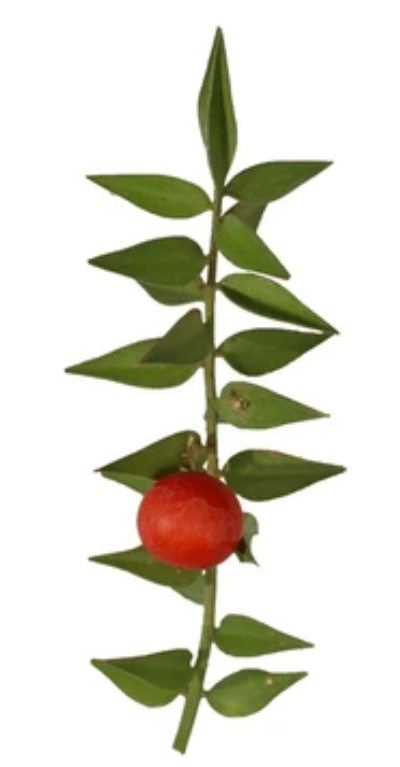
Morphology Small, bushy evergreen shrub reaching 25 to 80 cm. The "leaves" are actually cladodes (flattened stems), oval, leathery, dark green, ending in a sharp spine. Small whitish-green flowers appearing on the upper face of the cladodes. Bright red berries persisting throughout winter. Fleshy creeping rhizome. Part used & extraction The rhizome (underground root), by hydro-alcoholic extraction. The dry extract is standardised for total ruscogenins (minimum 1.5 to 5%). Harvested mainly in the Mediterranean region: southern France, Spain, Italy, Turkey. |
Ruscus aculeatus L. Spiny cladodes and characteristic bright red berries |
|
Active compounds & biochemistry |
Ruscogenins: steroidal saponins with unique vasoconstrictive properties in the plant kingdom
| Ruscogenins (neo- and ruscogenin) | Signature steroidal saponins of butcher's broom. Act on alpha-adrenergic receptors in the venous wall, inducing active vasoconstriction of veins and venules. Reduce pathological venous distensibility and increase venous return. A unique property among venotonic plants. |
| Flavonoids | Present as complementary compounds, they exert an antioxidant and anti-inflammatory action on the vascular endothelium, protecting the vessel wall from the oxidative and inflammatory damage associated with chronic venous stasis. |
| Dioscin & spirostanol | Secondary steroidal saponins contributing to the anti-inflammatory and diuretic action of the extract. Facilitate the elimination of interstitial fluid accumulated in tissues. |
| Phenolic compounds | Phenolic acids and hydroxycoumarin derivatives with antioxidant and mildly anticoagulant properties. Complete the overall vascular activity profile of the rhizome extract. |
|
Organoleptic properties |
Sensory characteristics of the dried rhizome and extract — identification and quality benchmarks
|
Appearance Dried rhizome Rhizome brown-beige to brown-grey, cylindrical, ringed. Clean break revealing a pale core. Powder beige to light ochre. |
Colour Dry extract / liquid Powder yellow-brown to orange-brown. Liquid extract: amber brown, translucent, slightly cloudy at high concentration. |
Odour Dried rhizome & extract Weak to moderate. Earthy and slightly woody notes, reminiscent of fresh rhizome. No pungent or unpleasant odour. |
Taste Extract in solution Bitter and acrid, with a slightly pungent note characteristic of saponins. Persistent, slightly astringent aftertaste. |
Solubility Dry extract Fine powder, good solubility in hydro-alcoholic medium. Soluble in hot water. Saponins confer a slight foaming effect in solution. |
|
Medicinal properties & traditional use |
The plant venous vasoconstrictor: ideal complement to red vine leaf and horse chestnut
|
Vasoconstrictor & venotonic Ruscogenins activate venous alpha-adrenergic receptors, triggering active contraction of the venous wall. Reduces the distension of varicose veins, improves the efficiency of venous valves and accelerates venous return to the heart. |
Lymphatic decongestant Stimulates lymphatic circulation and promotes drainage of accumulated interstitial fluid. Reduces oedema of the lower limbs. Used in premenstrual syndrome with water retention and mild lymphoedema. |
Haemorrhoids & anal pruritus Reduces congestion of the haemorrhoidal plexus via local vasoconstrictive action. Relieves haemorrhoidal pain, itching and bleeding. Used topically (creams, suppositories) as a complement to oral administration. |
| Usage note: Extract generally well tolerated. Not recommended during pregnancy or breastfeeding. Caution in cases of high blood pressure (vasoconstrictive action). Possible interaction with antihypertensive treatments. Often combined with vitamin C and other venotonic plants (red vine leaf, horse chestnut) for optimal synergy. |
| The mechanism of action of ruscogenins on venous alpha-adrenergic receptors is unique among venotonic plants: butcher's broom is the only plant capable of inducing active vasoconstriction comparable to that of certain synthetic drugs. |
Plant extracts are concentrated products. Consult a healthcare professional before use, especially during pregnancy, breastfeeding, medication or chronic illness.