


|
Standardized Plant Extract - TITREX® Mouse EarMouse Ear: The diuretic of arid soils, ally of the kidneys and edema |
Latin name Pilosella officinarum F.W.Schultz & Sch.Bip. Family Asteraceae |
|
History & Botany |
From hawk legends to modern studies: A humble plant with remarkable virtues
|
Mouse ear is a small stoloniferous perennial plant that thrives only on arid, dry, and poor soils of sandy areas, heaths, calcareous grasslands, and sunny embankments in Europe and Asia. Its Latin name, Hieracium, comes from the Greek hierax (hawk or sparrowhawk): according to an ancient Greek belief, the sparrowhawk would improve its sharp vision by feeding on its sap. This myth earned it a place among the sacred herbs of the Celtic Druids, who used it to "purify the blood." In the Middle Ages, it appeared in all herbals for treating wounds and stopping bleeding. It was Dr. Henri Leclerc who, around 1930, initiated the first scientific studies on mouse ear and confirmed its powerful diuretic properties. This foundational work was later confirmed by numerous subsequent studies, and the European Medicines Agency (EMA) now recognizes its traditional use for increasing urine production and facilitating the elimination of toxins. |
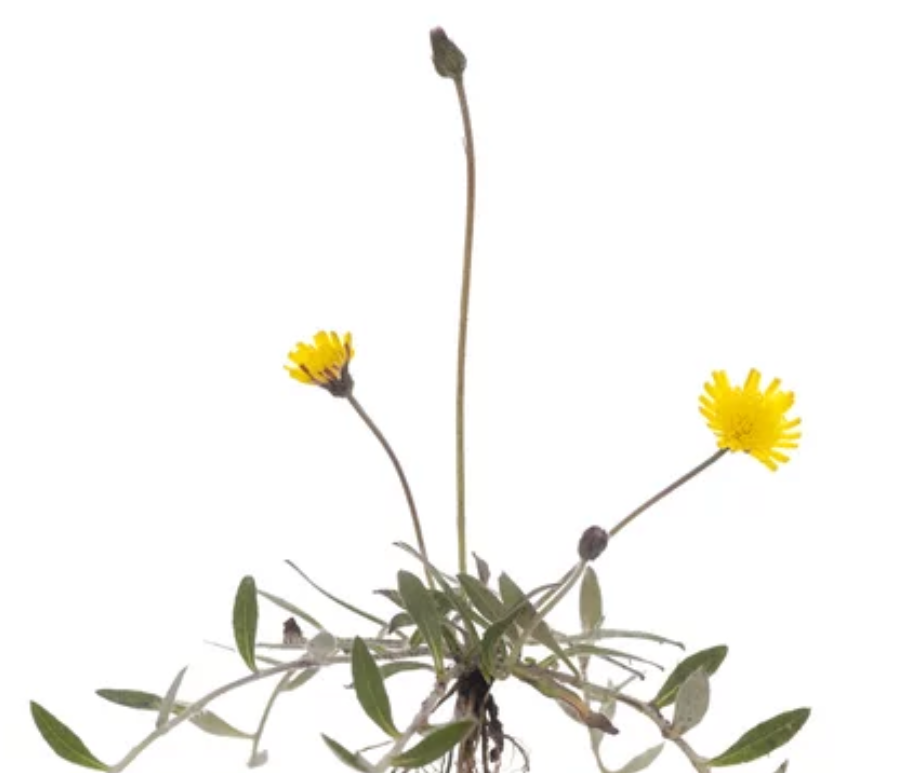
Morphology Small plant, 10 to 30 cm tall, recognizable by its oblong leaves covered with a fine grayish-white down, hence its nickname "Mouse Ear." Stoloniferous runners allow for rapid ground cover. Pale yellow flowers in solitary capitula borne on a single stem, slightly reddish on the outside. Fruits: grayish-white achenes topped with a silky pappus. Part used & extraction The whole flowering plant (aerial parts), harvested from May to September during flowering, quickly dried in the shade to preserve the umbelliferone and active flavonoids. Hydro-alcoholic extraction. Main harvesting countries: France, Spain, Bulgaria, Romania. |
Pilosella officinarum F.W.Schultz Solitary pale yellow capitulum and downy grayish leaves called "mouse ear" |
|
Organoleptic Characteristics |
What the senses reveal about the plant
|
Appearance Small grayish hairy plant, with characteristic white down on the leaves. Pale yellow flowers in solitary capitula. Dry extract powder is khaki-brown to green-brown, fine. |
Odor Slightly herbal and mild, characteristic of dry garrigue plants. Subtle and pleasant, without a pronounced note. The dry extract is almost odorless. |
Taste Slightly bitter and astringent, not pronounced and well tolerated. The astringency reflects the presence of active tannins and phenolic compounds. |
Infusion Liquid is light yellow to golden, slightly astringent, pleasant to drink. Often combined with orthosiphon or dandelion in renal drainage teas. |
|
Active Principles & Biochemistry |
Umbelliferone, dechlorinating flavonoids, and tannins: A diuretic complex with unique properties
| Umbelliferone (7-hydroxycoumarin) (active marker) | Signature coumarin and key molecule of mouse ear. Confirmed antibiotic, antioxidant, anti-inflammatory, and antihyperglycemic properties. Renal diuretic and detoxifying. Antibacterial against Pseudomonas aeruginosa, a frequent resistant germ in recurrent urinary tract infections. Allelopathic: also inhibits the growth of weeds. |
| Flavonoids (luteolin, cynaroside, isoquercetin) | Flavones with major diuretic properties and a rare and valuable characteristic: they eliminate water and chlorides retained in tissues, a unique dechlorinating effect absent from most other plant diuretics. Antioxidants, anti-inflammatory, and hepatoprotective. Isoquercetin also inhibits the growth of Pseudomonas aeruginosa, enhancing the antibacterial action of umbelliferone. |
| Chlorogenic acid & phenolic compounds | Powerful antioxidants, anti-inflammatory, and antimicrobial agents. Contribute to renal and hepatic detoxifying action. Chlorogenic acid contributes to mild hypoglycemic effects. Phenolic compounds provide astringent protection for urinary and digestive mucous membranes. |
| Tannins & alcohol-acids | Astringent and hemostatic properties, traditionally validated for stopping epistaxis and bleeding from minor wounds. Contribute to the plant's depurative and antimicrobial properties. Protective for urinary mucous membranes weakened by recurrent infections. |
|
Medicinal Properties & Traditional Use |
Usage recognized by the EMA: Natural dechlorinating diuretic among the most effective
|
Powerful Diuretic & Dechlorinating The flavonoids of mouse ear eliminate water and chlorides retained in tissues — a rare and valuable property. Preferred action on water retention, edema, cellulite, and heavy legs. Recognized by the EMA for increasing diuresis and facilitating the elimination of toxins. |
Depurative & Urinary Anti-Infective Promotes the elimination of renal toxins. Antibacterial properties against urinary tract germs, particularly Pseudomonas aeruginosa. Traditionally used for mild cystitis, urinary tract infections, kidney stones, and gout. Recognized blood depurative. |
Hepatoprotective & Anti-Inflammatory Documented hepatoprotective properties via flavonoids and chlorogenic acid. Anti-inflammatory for joints and urinary tract. Traditional treatment for rheumatism and arthritis linked to uric acid accumulation. Vulnerary in external use (wounds, bruises, epistaxis). |
Antioxidant & Metabolic Umbelliferone and flavonoids provide systemic antioxidant cellular protection. Mild antihyperglycemic properties of umbelliferone (alpha-glucosidase inhibition). Hemostatic in external use. Emerging interest in the prevention of diabetic nephropathy. |
| Usage note: Drink plenty (1.5 to 2 liters of water per day) during the course to maximize the diuretic effect and avoid concentration of eliminated waste. Courses of 2 to 4 weeks, renewable. Not recommended in cases of severe renal or cardiac insufficiency. Caution with medicinal diuretic treatments (potentiation). Coumarins may interfere with anticoagulants (vitamin K antagonists); inform your doctor. Not recommended during pregnancy. |
| The European Medicines Agency (EMA) recognizes the traditional use of mouse ear for increasing urine production and facilitating the elimination of toxins, the only diuretic plant to combine this effect with a unique tissue dechlorinating action, making it the essential ally for edema and refractory cellulite. |
TITREX® products are dietary supplements and not medicines. They should not replace a healthy and balanced diet.