


|
Plant Extract - TITREX Phytotherapy ValerianCatnip: Sedative, anxiolytic, and sleep-regulating |
Latin name Valeriana officinalis L. Family Valerianaceae |
|
History & Botany |
From the damp meadows of Europe to the world's pharmacopoeias: Two millennia of the reference sedative plant
|
Valerian is a perennial plant found in damp meadows, forest edges, and stream banks of temperate Europe and Asia, growing wild up to 2,000 meters in altitude in the Alps and Pyrenees. Its Latin name, Valeriana, likely derives from the Latin valere (to be in good health, to be strong), testifying to the excellence of its medicinal reputation. Dioscorides and Galen mentioned it under the name phu and attributed diuretic and pain-relieving properties to it. Its sedative and calming properties became definitive in the Middle Ages, and the plant was included in many pharmacopoeias from the 16th century onward. During World War I, it was widely administered to treat war neurosis and acute anxiety states. Modern phytochemistry identifies valerenic acid as the main compound responsible for the sedative activity. The EMA now recognizes its well-established traditional use for mild insomnia and nervousness. |
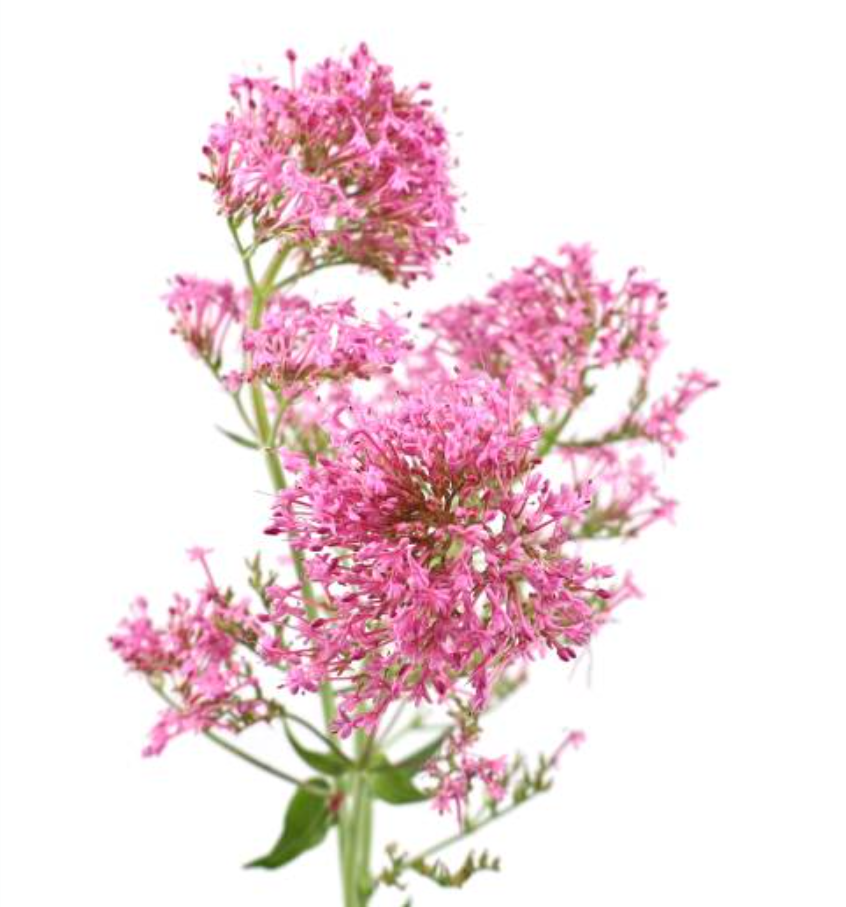
Morphology Robust perennial plant, 50 to 150 cm tall, with a hollow, upright, and striated stem. Opposite, pinnatisect leaves with lanceolate, toothed leaflets. Tiny pale pink to light lilac flowers in dense terminal corymbs, fragrant, from June to August. The rhizome and roots, with a strong and earthy characteristic odor, constitute the medicinal drug. This odor is irresistibly attractive to cats — hence the popular nickname "catnip." Part used & extraction The rhizome with roots and rootlets, harvested in autumn (2nd or 3rd year of cultivation), dried at low temperature, and subjected to hydro-alcoholic extraction. The dry extract is standardized in valerenic acid (minimum 0.17 to 0.8%). Main producers: Belgium, France, Germany, Netherlands, Poland. |
Valeriana officinalis L. Characteristic pale pink corymbs and fleshy rhizome with a strong odor |
|
Organoleptic Characteristics |
What the senses reveal about the plant
|
Appearance Roots and rhizome are gray-brown on the outside, cream-white on the inside, fleshy and fibrous. Dry extract powder is beige-brown, fine, and homogeneous. |
Odor Strong, earthy, and musky, slightly animal-like, due to the isovalerate released during drying. Characteristic and immediately recognizable. Irresistible to cats. |
Taste Bitter, acrid, and slightly aromatic, persistent and unpleasant, justifying the preferential use in capsule or encapsulated extract form to mask the taste. |
Infusion Liquid is dark ochre-brown and cloudy, with a pronounced earthy odor. Often flavored with mint or linden to mask the strong taste. The infusion is less active than the dry extract (valepotriates are unstable). |
|
Active Principles & Biochemistry |
Valerenic acid, valepotriates, and GABA: Complex sedative chemistry acting on central nervous system receptors
| Valerenic acid & derivatives (sesquiterpenes) | Quality marker and main responsible for sedative activity. Valerenic acid inhibits the enzymatic degradation of GABA in the synaptic clefts and positively modulates GABA-A receptors, the same mechanism as benzodiazepines, but gently and non-addictively. Reduces anxiety and promotes sleep without amnesic effects or dependence at recommended doses. |
| Valepotriates (monoterpene iridoids) | Valtrate, isovaltrate, and didrovaltrate. Complementary sedative and anxiolytic properties to valerenic acid. Chemically unstable (degrade during drying and extraction), which explains why aqueous extracts are often poor in these compounds. Contribute to the characteristic odor of the dried root via their degradation product, baldrianol. |
| Isovaleric acid & esters | Responsible for the strong and characteristic odor of the dried root. Mild sedative properties in themselves. Isovaleric acid is a short-chain branched fatty acid that forms during the enzymatic degradation of valepotriates and while the roots are drying. |
| Lignans & flavonoids | Linarin, hesperidin, and 6-methylapigenin (flavone). The latter binds to benzodiazepine receptors with documented affinity, contributing to the overall anxiolytic effect of the extract. Lignans exert synergistic sedative action and mild antispasmodic activity on smooth muscle. |
| Free GABA & glutamine | The valerian root contains small amounts of free GABA and glutamine (GABA precursor). Although GABA does not directly cross the blood-brain barrier, these compounds may contribute to the sedative effect through peripheral pathways and action on the vagus nerve, a mechanism currently being elucidated by research. |
|
Medicinal Properties & Traditional Use |
The reference herbal sleep aid: Recognized by the EMA for mild insomnia and nervousness
|
Insomnia & Sleep Disorders Reduces the time to fall asleep, improves sleep quality and depth. Decreases nighttime awakenings without causing daytime drowsiness or rebound effects upon discontinuation. Well-established EMA indication. Optimal efficacy after 2 to 4 weeks of regular intake (cumulative effect; do not judge based on a single dose). |
Anxiety & Nervousness Reduces mild to moderate anxiety, nervous tension, and psychomotor agitation. Indicated for chronic stress, hypervigilance states, and functional anxiety disorders. No daytime sedative effect at recommended doses, can be taken during the day. |
Antispasmodic & Somatizations Relaxes spasms of the smooth digestive and vascular muscles of nervous origin. Indicated for functional bowel disorders, spastic colic, anxiety-related palpitations, tension headaches, and stress somatizations (stomach knots, chest tightness). |
Benzodiazepine Withdrawal Used to support the gradual withdrawal from chemical sleeping pills and anxiolytics. Sharing part of the same GABAergic mechanism, it attenuates withdrawal symptoms (rebound insomnia, anxiety, agitation) without creating its own dependence. A clinical study on TITREX Valerian documented successful withdrawal in 4 weeks. Always under medical supervision. |
| Usage note: Valerian acts cumulatively: optimal effects on sleep are achieved after 2 to 4 weeks of regular daily intake. Usual dose: 300 to 600 mg of standardized extract, 30 minutes to 1 hour before bedtime. Do not combine with alcohol, benzodiazepines, or chemical sleeping pills without medical advice. Avoid driving if drowsiness is felt. Not recommended during pregnancy and breastfeeding, or for children under 12 years old. Inform the anesthetist before any surgical procedure (possible interaction with anesthetics). |
| Valerian is the only sedative plant whose mechanism of action, positive modulation of GABA-A receptors, is identical to that of benzodiazepines, but without creating dependence or amnesia, and without altering the natural architecture of paradoxical sleep. |
Plant extracts are concentrated products. Consult a healthcare professional before use, especially in cases of pregnancy, breastfeeding, medication, or chronic conditions.