


|
Plant Extract — Herbal Medicine Common SageHe who has sage in his garden needs no physician — Antiperspirant, oestrogenic and digestive |
Latin name Salvia officinalis L. Family Lamiaceae |
|
History & Botany |
From the Mediterranean basin to medieval monasteries — the sacred plant of Greco-Roman medicine
|
Common sage is a perennial aromatic plant native to the Mediterranean basin, particularly widespread in the dry garrigue of Dalmatia, Spain and southern France. Its Latin name Salvia derives from salvare (to save, to heal), reflecting the extraordinary medicinal reputation accorded to it by the Romans. Dioscorides and Hippocrates cited it for its haemostatic, digestive and antiseptic properties. The Latin saying « cur moriatur homo cui salvia crescit in horto ? » (why should a man die who has sage growing in his garden?) sums up the immense trust placed in it by physicians of Antiquity. In the Middle Ages, Benedictine monks made it the queen plant of their medicinal gardens. Modern herbal medicine rediscovered its antiperspirant and oestrogenic properties from the 1970s onwards, identifying a major application in the management of menopausal symptoms. The EMA now recognises two well-established traditional indications: treatment of mild to moderate hot flushes and reduction of excessive sweating. |
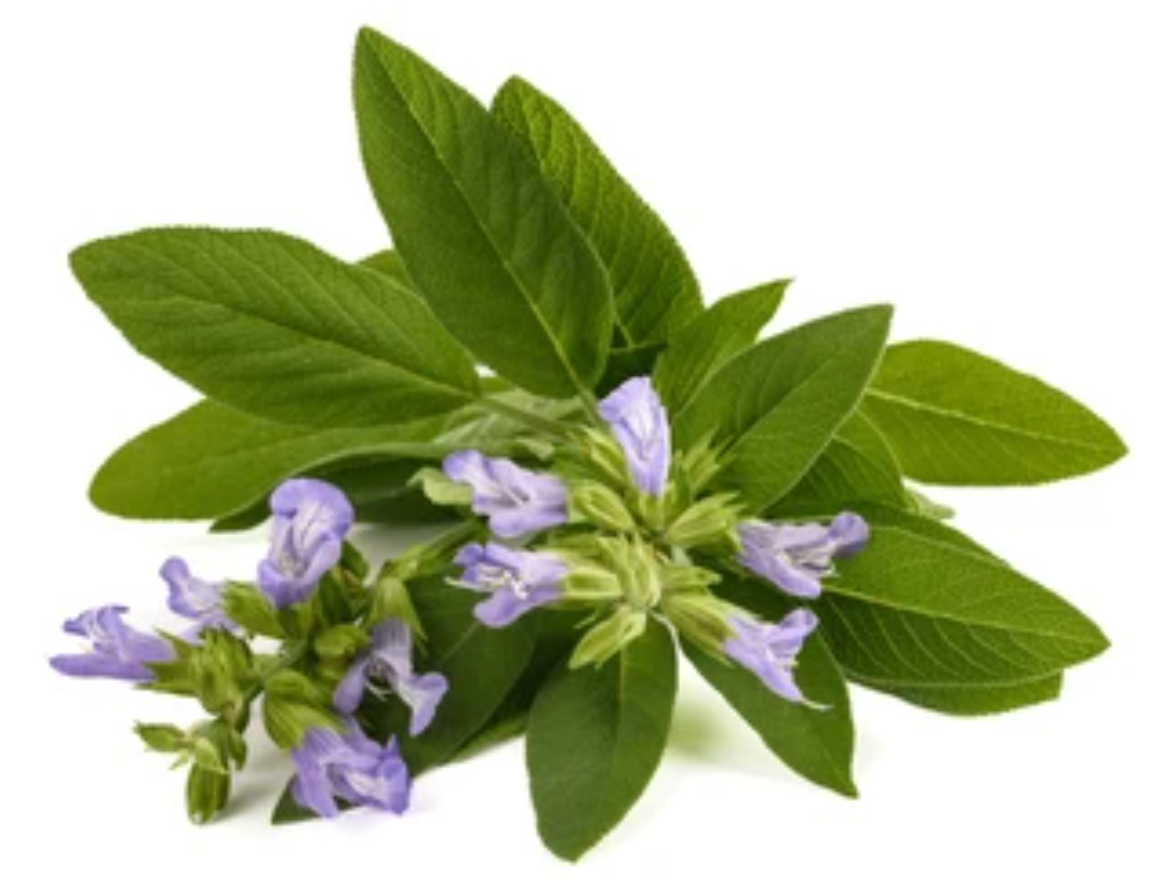
Morphology Perennial sub-shrub 30 to 80 cm tall. Woody stems at the base, square and woolly at the top. Opposite, oblong leaves, grey-green and velvety, with a wrinkled surface, highly aromatic when rubbed. Blue-violet bilabiate flowers in spaced whorls, highly nectariferous, from May to July. Part used & extraction The leaves, harvested before full flowering, dried and subjected to hydro-alcoholic extraction. The dry extract is standardised in rosmarinic acid and phenolic diterpenes. Main origin: Dalmatia (Croatia), Spain, France. |
Salvia officinalis L. Characteristic grey-green velvety leaves and blue-violet flowers |
|
Active Constituents & Biochemistry |
Phenolic diterpenes, rosmarinic acid and essential oil — a complex chemistry with multiple therapeutic dimensions
| Phenolic diterpenes (carnosic acid, carnosol) | Signature molecules of sage and rosemary. Carnosic acid and carnosol are powerful lipid-soluble antioxidants. Anti-inflammatory properties (COX-2 inhibition), neuroprotective and mildly phyto-oestrogenic. Partly responsible for the antiperspirant and hypothalamic regulatory effect. |
| Rosmarinic acid | Major antioxidant polyphenol, anti-inflammatory and antimicrobial. Inhibits complement activation and lipid peroxidation. Documented antiviral and neuroprotective properties. Quality marker for standardised sage extracts. |
| Flavonoids (luteolin, apigenin, salvigenin) | Antioxidant, anti-inflammatory and mildly oestrogen-like properties. Luteolin is a selective oestrogen receptor modulator (plant SERM), contributing to the climacteric action of the extract. Antispasmodic activity on smooth digestive musculature. |
| Essential oil (thujone, 1,8-cineole, camphor) | Present in the extract at low concentrations. Responsible for the antiseptic, digestive and tonic properties of sage. Thujone (neurotoxic at high doses in pure essential oil) is present at safe levels in hydro-alcoholic extracts at recommended doses. |
|
Organoleptic Properties |
Sensory characteristics of the dried leaf and extract — identification and quality benchmarks
|
Appearance Dried leaf Grey-green velvety leaves, rough, with a characteristic wrinkled surface. Powder grey-green to khaki-green, slightly downy. |
Colour Dry / liquid extract Powder brown-green to brown-ochre. Liquid extract: amber-brown to greenish-brown, translucent, slightly colouring. |
Odour Dried leaf & extract Pronounced aromatic, camphoraceous and herbaceous, slightly camphor-eucalyptus. Highly distinctive, characteristic of Mediterranean Lamiaceae. |
Taste Extract in solution Aromatic, bitter and slightly astringent, with a persistent camphoraceous note and a slight warmth in the mouth. Very recognisable culinary flavour. |
Solubility Dry extract Fine powder, good hydro-alcoholic and hot water solubility. Lipophilic constituents (essential oil) dissolve better in alcoholic media. |
|
Medicinal Properties & Traditional Use |
The essential menopause ally — recognised by the EMA for hot flushes and excessive perspiration
|
Antiperspirant & hot flushes Well-established EMA indication. Reduces excessive sweating (hyperhidrosis) by 50 to 60% within 4 weeks in clinical studies. Significantly attenuates hot flushes and night sweats during menopause. Mechanism: hypothalamic regulatory and peripheral anticholinergic action. |
Phyto-oestrogenic & menopause Its flavonoids and diterpenes exert a gentle plant SERM action on beta oestrogen receptors. Relieves vaginal atrophy, improves mood and sleep quality. Often combined with lady's mantle and alfalfa in menopause complexes. |
Digestive & antispasmodic Stimulates bile secretion and digestive enzymes. Indicated for dyspepsia, bloating, spastic colitis and digestive sluggishness. Antiseptic properties on pathogenic digestive flora. Well-established traditional use as a carminative and eupeptic. |
Antimicrobial & oral health Antiseptic for the ENT and oral sphere: gargles for sore throats, gingivitis, mouth ulcers, stomatitis. Inhibits Streptococcus mutans and pathogens responsible for throat infections. Antifungal properties against Candida albicans. |
| Usage note: Contraindicated during pregnancy and breastfeeding (emmenagogic properties and presence of thujone). Not recommended in patients with a history of hormone-dependent cancer (breast, uterus, ovary): consult an oncologist. In epilepsy, avoid thujone-rich extracts. Aqueous and hydro-alcoholic extracts at recommended doses are well tolerated. Treatment courses of 4 to 8 weeks, renewable. |
| A randomised double-blind clinical study (Bommer et al., 2011) showed that a daily intake of fresh sage extract reduced the intensity of severe hot flushes by 64% over 8 weeks, with an excellent tolerability profile. |
Plant extracts are concentrated products. Consult a healthcare professional before use, particularly during pregnancy, breastfeeding, when taking medication or in cases of chronic illness.