


|
Plant Extract - Female Phytotherapy Lady's MantleThe women's herb: Female cycle, PMS, endometriosis, and natural hormonal balance |
Latin name Alchemilla vulgaris L. (agg.) Family Rosaceae |
|
History & Botany |
From Alpine meadows to phytotherapy laboratories: The alchemists' plant serving the female cycle since the Middle Ages
|
Lady's mantle is a perennial herbaceous plant found in the damp meadows of temperate Europe and Asia, particularly abundant in the Alpine and Pyrenean mountain regions. Its Latin name, Alchemilla, comes from the Arabic alkemelyeh, referring to medieval alchemists who collected the dew drops that form in the cups of its lobed leaves, considered pure water with magical virtues. In the 12th century, Hildegard von Bingen recommended it for uterine inflammation and cycle regulation. Since the Middle Ages, herbalists have given it the nickname "women's herb" due to its beneficial effects on the menstrual cycle, menstrual pain, and female hormonal disorders. Alpine folk medicine used it until the 20th century as a menstrual regulator, hemostatic, and healing agent. Modern phytochemistry identifies ellagic tannins and progesterone-like flavonoids as the main compounds responsible for its properties, validating a traditional use dating back several centuries. It is listed in the European Pharmacopoeia. |
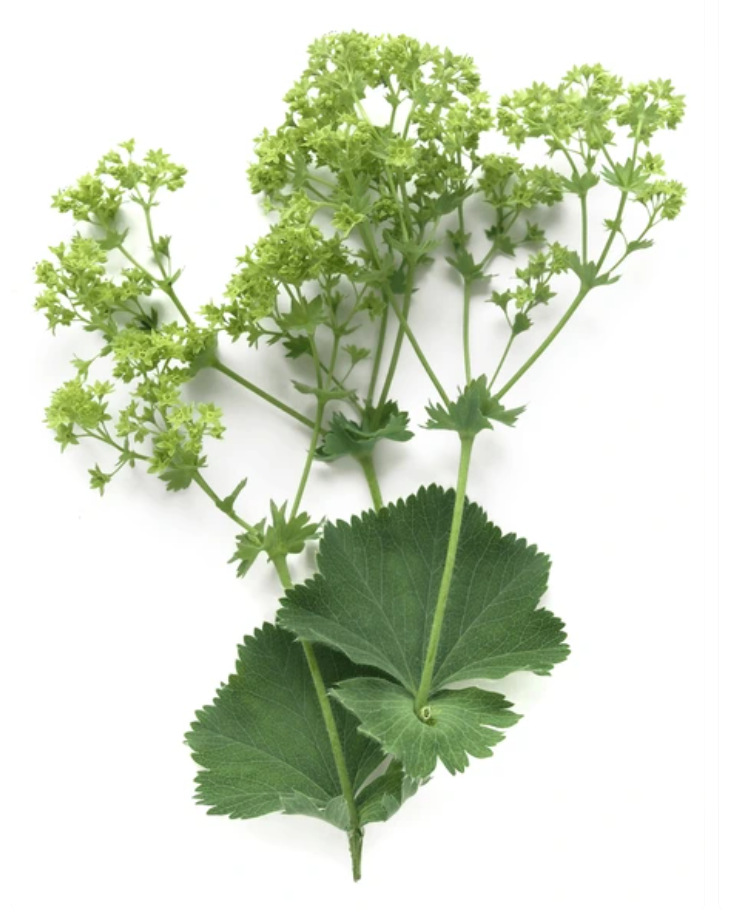
Morphology Small perennial plant, 10 to 50 cm tall, with palmate leaves with 7-11 rounded and toothed lobes, finely velvety. The hydrophobic surface retains dew drops as small shiny beads, a immediately recognizable botanical feature. Tiny green-yellow flowers in loose cymes, without petals, from May to September. Vigorous rhizome and creeping stolons. Part used & extraction The flowering aerial parts (leaves, stems, and flowers), harvested from May to July, dried, and subjected to hydro-alcoholic extraction. The dry extract is standardized in total tannins (minimum 5 to 8%). Mainly harvested in Central and Eastern Europe (Romania, Poland, Hungary) and the French Alps. |
Alchemilla vulgaris L. Characteristic palmate leaves and green-yellow flowers |
|
Active Principles & Biochemistry |
Ellagic tannins, progesterone-like flavonoids, and phytosterols: A polyphenolic triad serving menstruating women
| Ellagic & gallic tannins (5 to 8%) | Major active principles. Ellagic acid, gallic acid, pedunculagin, agrimoniin: powerful astringent, hemostatic, and anti-inflammatory properties. Tighten the uterine mucosa, reduce menstrual bleeding, and inhibit pro-inflammatory mediators (COX-2, prostaglandins PGE2) responsible for cramps. |
| Flavonoids (quercetin, luteolin, kaempferol) | Selective modulators of estrogen receptors (plant SERMs). Luteolin exerts a slightly progesterone-like action that counterbalances excess estrogen, helping to correct estrogen dominance involved in severe PMS, fibroids, and endometriosis. Powerful anti-inflammatories inhibiting pro-inflammatory prostaglandins. |
| Phytosterols (beta-sitosterol) | Modulate the binding of estrogens to their receptors and exert a slightly progesterone-like action in the luteal phase. Contribute to natural hormonal rebalancing, supporting the deficient post-ovulatory phase in many functional menstrual disorders. |
| Ursolic acid & triterpenes | Anti-inflammatory, antimicrobial, and healing properties for the genital mucosa. Ursolic acid inhibits NF-kB, a central pathway of chronic pelvic inflammation involved in endometriosis and chronic pelvic pain. |
|
Organoleptic Properties |
Sensory characteristics of the dry plant and extract — identification and quality benchmarks
|
Appearance Dry plant Leaves are dull green to gray-green, palmate, finely velvety. Tiny green-yellow flowers. Slightly downy texture to the touch. |
Color Dry extract / liquid Powder is khaki green to brown-green. Liquid extract: amber-brown to green-brown, translucent, slightly darkening in air. |
Odor Dry plant & extract Weakly aromatic. Fresh, herbal, and vegetal notes, slightly earthy. No strong odor, typical of tannin-rich plants. |
Taste Extract in solution Clearly astringent (ellagic tannins), with herbal and slightly bitter notes. Characteristic sensation of tightening and dryness in the mouth. |
Solubility Dry extract Fine powder, slightly hygroscopic. Good hydroalcoholic solubility. Partially soluble in cold water; hot infusion recommended. |
|
Medicinal Properties & Use in Menstruating Women |
From dysmenorrhea to endometriosis: The flagship plant for painful female cycles
|
Dysmenorrhea & Menstrual Cramps Tannins and flavonoids inhibit the synthesis of PGE2 and PGF2α prostaglandins, direct mediators of uterine cramps. Reduce the intensity and duration of menstrual pain by acting on the inflammatory mechanism causing painful contractions, without the gastric side effects of NSAIDs. |
Premenstrual Syndrome (PMS) Reduces all PMS symptoms: breast swelling, bloating, water retention, irritability, catamenial migraines, and premenstrual fatigue. The progesterone-like action of flavonoids corrects the estrogen/progesterone imbalance in the luteal phase underlying severe PMS. |
Menorrhagia & Metrorrhagia The powerful hemostatic action of ellagic tannins significantly reduces heavy menstrual bleeding (menorrhagia) and intermenstrual bleeding (functional metrorrhagia). Tones the uterine mucosa and tightens endometrial vessels, limiting excessive blood loss. |
Irregularities & Anovulatory Cycles Regulates irregular cycles, spanomenorrhea, and functional amenorrhea related to stress or moderate hormonal imbalances. Supports the luteal phase and promotes regular ovulation by rebalancing the estrogen/progesterone ratio. |
|
Endometriosis & Chronic Pelvic Pathologies |
Natural support for women suffering from endometriosis: Anti-inflammatory, anti-proliferative, and pain-relieving action
|
Endometriosis is a chronic estrogen-dependent inflammatory disease: ectopic endometrial tissues proliferate under the influence of estrogens and maintain chronic pelvic inflammation through the production of prostaglandins, pro-inflammatory cytokines, and free radicals. Lady's mantle acts at several levels of this cascade: ‣ Reducing estrogen dominance: The progesterone-like flavonoids and phytosterols in lady's mantle modulate estrogen receptors, counterbalancing the relative hyperestrogenism that promotes the proliferation of endometriotic lesions. By correcting this imbalance, they help slow the progression of lesions. ‣ Powerful pelvic anti-inflammatory: Ellagic tannins and ursolic acid inhibit NF-kB and COX-2, two central pathways of chronic pelvic inflammation. Reduce the local production of prostaglandins and pro-inflammatory cytokines (IL-1β, TNF-α) that maintain chronic pelvic pain. ‣ Menstrual pain relief: Significantly reduces pre-, per-, and post-menstrual pain related to endometriosis, often among the most severe experienced by affected women (grade 3-4 dysmenorrhea). A natural complement to drug treatments, sometimes allowing a reduction in the use of NSAIDs. ‣ Uterine fibroids: The mild anti-estrogenic action of lady's mantle may help slow the growth of estrogen-dependent fibroids by reducing the hormonal stimulation responsible for their development. Results vary depending on the size and age of the fibroids. ‣ Functional ovarian cysts: By regulating the luteal phase and ovulation, lady's mantle can help prevent the formation of functional cysts linked to anovulatory cycles. It does not act on organic cysts (endometriomas) but supports the hormonal balance favorable to their prevention. |
| Important: Lady's mantle is not a curative treatment for endometriosis. It provides complementary phytotherapeutic support as part of a comprehensive management plan supervised by a doctor or gynecologist. It can be combined with other anti-inflammatory plants (turmeric, omega-3, yarrow) in an integrative approach. Any suspicion of endometriosis should lead to a specialized medical consultation. |
| Usage note: Not recommended during pregnancy (uterine tonic action). Take away from iron-rich meals (tannins reduce its absorption). Possible interactions with hormonal treatments: consult a healthcare professional. 3-month courses are recommended for chronic indications (endometriosis, PMS), renewable. Lady's mantle is often combined with alfalfa, sage, and yarrow in female cycle complexes. |
| Lady's mantle is one of the few medicinal plants that combines hemostatic action, progesterone-like hormonal regulation, and a powerful pelvic anti-inflammatory effect, a unique profile that makes it the reference plant for painful female cycles. |
Plant extracts are concentrated products. Consult a healthcare professional before use, especially in cases of pregnancy, breastfeeding, medication, or chronic illness.