


|
Vegetable Oil - Cosmetic & Nutraceutical Borage OilThe star of gamma-linolenic acid - Skin anti-aging, female hormone balance, and systemic anti-inflammatory |
Latin name Borago officinalis L. Family Boraginaceae |
|
History & Botany |
From medieval gardens to dermatological laboratories: The plant of courage with the seeds richest in GLA
|
Borage is an annual plant native to the eastern Mediterranean basin (likely Syria and Lebanon), naturalized throughout temperate Europe since antiquity. Its name comes from the Arabic abu rach (father of sweat), referring to its traditional sudorific properties. The Celts believed it gave courage to warriors: they infused its flowers in wine before battles. Dioscorides and Pliny the Elder recommended it as a euphoric, cordial, and medicinal plant. It was in the 1980s that the exceptional gamma-linolenic acid (GLA) content of its seed oil (18 to 26%, the highest of all known vegetable oils) was discovered, propelling borage to the status of a star in anti-aging cosmetics and female nutraceuticals. It surpasses evening primrose (8-12% GLA) and black currant (15-19%), making it the most powerful plant source of GLA available. |
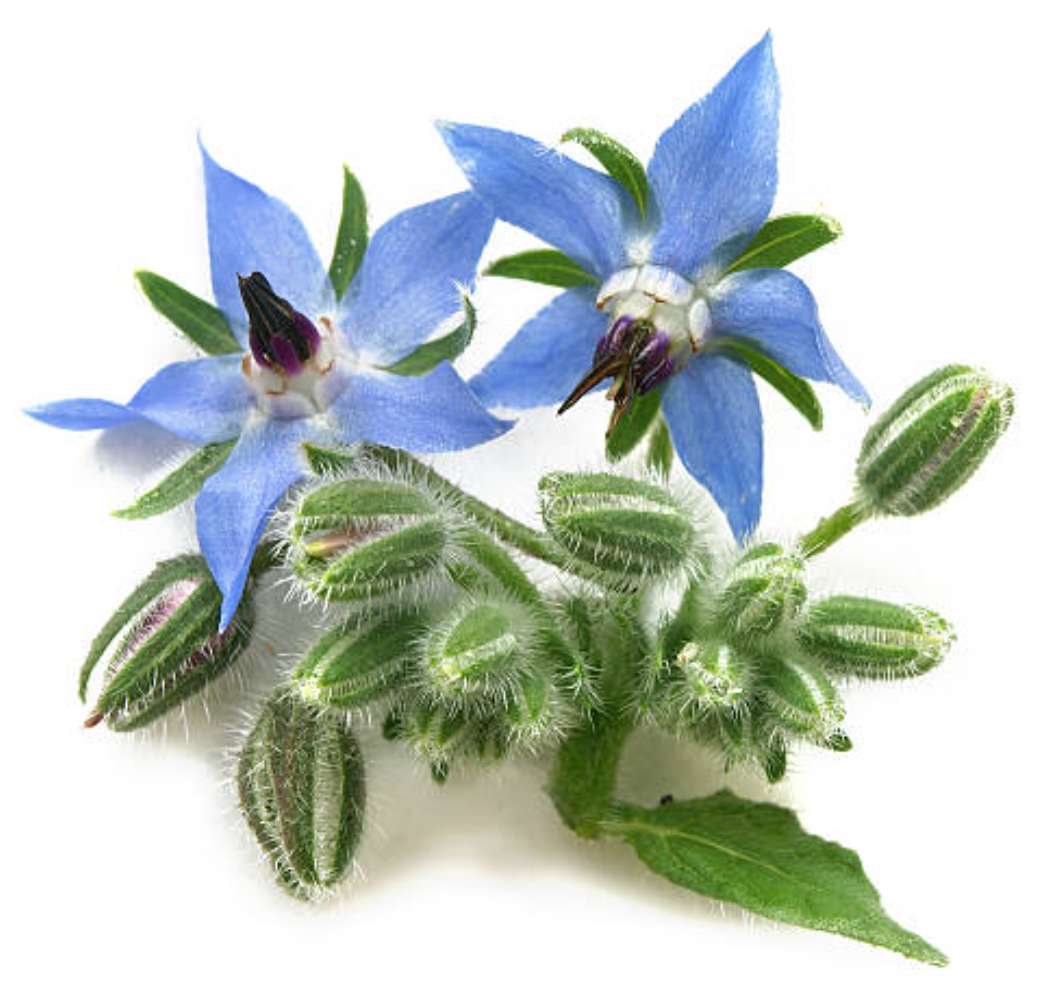
Morphology Robust annual plant, 30 to 80 cm tall, entirely covered with stiff white hairs. Alternate, oval, fleshy, and very hairy leaves. Star-shaped flowers with 5 bright intense blue petals, with black stamens forming a central cone. One of the brightest blue flowers in the plant kingdom. Tiny brown seeds (tetrakene) with high lipid content. Oil extraction Extraction by cold first pressing of the seeds, without solvents or heat. Low yield (about 15%), making it an expensive oil. Light golden-yellow color with a slight greenish tint. Refrigeration required for storage (6 to 12 months). Main producers: France, England, Germany, Canada. |
Borago officinalis L. Characteristic star-shaped blue flowers and hispid leaves |
|
Fatty Acid Composition & Biochemistry |
An exceptional lipid profile centered on gamma-linolenic acid: The most concentrated plant source of GLA in the world
| Gamma-linolenic acid - GLA (18 to 26%) | Omega-6 fatty acid with 3 unsaturations, the key molecule of the oil. Direct precursor of series 1 prostaglandins (PGE1) with anti-inflammatory, vasoprotective, and immunomodulatory actions. Bypasses the delta-6-desaturase enzyme, often deficient in women suffering from PMS, menopause, or chronic eczema. |
| Linoleic acid - LA (35 to 38%) | Essential omega-6 precursor of GLA. Major component of skin ceramides and the hydrolipidic film. Restores the skin barrier in dry, atopic, and dehydrated skin. With GLA, forms the most effective lipid repair duo in cosmetics. |
| Oleic acid (15 to 20%) | Penetrating and restructuring omega-9. Improves cellular membrane fluidity and promotes the skin penetration of other active components. Partially stabilizes the oil against oxidation. |
| Tocopherols & phytosterols | Natural vitamin E (alpha and gamma tocopherols) protects the oil from oxidation and cellular membranes from oxidative stress. Phytosterols (beta-sitosterol, campesterol) with skin anti-inflammatory properties and cholesterol absorption modulating effects. |
|
Organoleptic Properties |
Sensory characteristics of virgin borage oil : identification and quality benchmarks
|
Appearance Virgin oil A fluid and clear oil, light, non-greasy to the touch. Rapid skin penetration. Slightly more viscous than evening primrose oil due to its higher GLA content. |
Color Fresh virgin oil Golden yellow to yellow-green, slightly more colored than evening primrose oil. A brown-orange or cloudy color indicates advanced oxidation. |
Odor Fresh oil Slightly vegetal and herbal, more pronounced than evening primrose oil, with a slightly fatty note. A rancid or fishy odor indicates oxidation: do not use. |
Taste Oil in solution Slightly vegetal and somewhat bitter, with a more pronounced herbal note than evening primrose oil. Generally administered in capsules to avoid this taste for internal use. |
Storage Oxidative stability A very fragile oil, rich in PUFAs. Mandatory refrigeration, away from light and air. Added vitamin E recommended. Shelf life: 6 to 12 months once opened. |
|
Properties & Uses |
Skin anti-aging, hormonal balance, and systemic anti-inflammatory: An oil with dual cosmetic and therapeutic vocations
|
Skin Anti-Aging & Firmness GLA stimulates the synthesis of ceramides and hyaluronic acid in keratinocytes, restoring suppleness, hydration, and density to mature skin. Reduces dehydration wrinkles. Improves skin elasticity in 6 to 8 weeks of application. Indicated for dry, dehydrated, dull, and aging skin. |
PMS & Female Hormonal Balance The conversion of GLA into PGE1 helps regulate estrogen sensitivity and reduce PMS symptoms: mastodynia, irritability, water retention, and catamenial migraines. Complementary to evening primrose, borage is often preferred for its GLA concentration, which is twice as high. |
Dermatosis & Atopic Skin Recognized effectiveness in atopic eczema, psoriasis, and seborrheic dermatitis. GLA restores the deficient skin barrier, reduces itching, and inflammatory flare-ups. Used in topical application and orally. In pediatric dermatology, often preferred in topical application. |
Systemic Anti-Inflammatory Orally, GLA reduces markers of systemic inflammation (CRP, IL-6, TNF-α). Indicated in rheumatology: rheumatoid arthritis, inflammatory osteoarthritis. Reduces morning stiffness and joint pain after 12 weeks of supplementation. |
| Usage note: Cosmetic use: Apply pure or diluted (10 to 30% in a base oil) on the face and body. Light texture, rapid penetration. Internal use: 500 mg to 1 g of GLA/day (or 2 to 4 g of borage oil). Store in the refrigerator, away from light. Not recommended for people on anticoagulants. Imperative to choose seed oils certified free of pyrrolizidine alkaloids. Pregnancy: Medical advice recommended. |
| With 18 to 26% gamma-linolenic acid, borage oil is the most concentrated plant source of GLA known to date, surpassing evening primrose, black currant, and all other vegetable oils in their supply of this essential anti-inflammatory fatty acid. |
Vegetable oils are concentrated natural products. Consult a healthcare professional before internal use, especially in cases of pregnancy, breastfeeding, or medication.